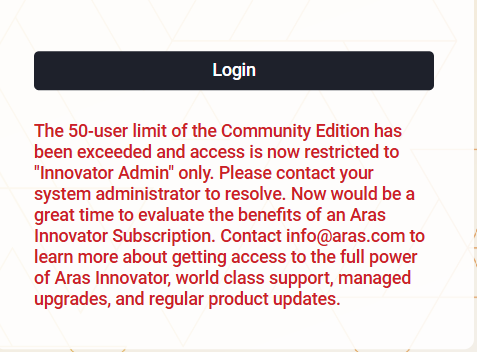
They have the “Minecraft of PLM” but use the sales concept of Fallout 76.
Here is an overview of whats new in Release 2025/35: https://aras.com/ja-jp/blog/arasinnovator-release35 Aras changed A LOT! This release contains a complete rework of the UI/UX! Huge respect to the developers and the other people who work "hand-on" on the software!
BUT: This Japanese blog article is the ONLY Release 35 related content I have seen so far. Did you know that the new AI assistant was released a few days ago too? Did you hear anything from their marketing, despite some press release article an eternity ago? Any advertising? Nothing!!!!!
They have the best product in years, yet they’re probably totally confused why the sales figures don’t magically skyrocket by themselves. But of course this was part of the original Aras sales concept. Give the product away for free to save marketing costs. Solid concept. Well, until you eliminate the open release itself.
There was an opportunity to sunset the open release with care — supporting open release users with a guided transition to a regular version (e.g. Minerva PLM) and honoring the product’s legacy. But instead, they opted for a hard cutoff practically overnight.
I have installed the Community Edition 2025 and my first impressions is that, they heavily worked with UI changes and it looks nice. Rest is same as before maybe need some more time to test. However RE package for Release 2025 is missing but I see packages for all other Modules
I confirm that the RE package for Release 2025 is missing. You can probably still use the previous version, but I assume Aras just forgot to add the new package. The lastest RE version was released for Release 33 and contained new useful features like spellcheck, drag&drop and other quality of live improvements. So this version would definitely be a win.
@ALL
Could someone verify whether Aras has updated the user restrictions to align with the current descriptions on the homepage and in the Administrator Quick Start Guide?
- According to the homepage Release 2025 supports up to 50 users - According to the Administrator Quick Start only "enabled" users are counted.
Back in Release 2024, system accounts and "disabled" users were counted too.
Questions:
1. Is the user limit strictly 50, or is it slightly higher - around 53-55 - to accommodate system accounts such as Vault and Authentication Admin? 2. If you exceed the user limit and disable some of the accounts, does Innovator work again? Are disabled accounts still counted as "active" users?
Here is a small C# Method that can be used to add some "Test Users" fast and easy. The Method will add 47 users. Please lower the "new user" number if you already have added your own custom accounts.
Notes: Only use this code in a dedicated test environment. Please don´t add very large numbers of users with this Method. This may have negative impact to your system performance.
Innovator inn = this.getInnovator();

int amountNewUsers = 47;

StringBuilder amlBuilder = new StringBuilder("<AML>");
for (int i=0; i < amountNewUsers; i++)
{
    amlBuilder.Append($@"
        <Item type=""User"" action=""add"">
            <login_name>Test {i+1}</login_name>
            <first_name>Test</first_name>
            <last_name>User {i+1}</last_name>
            <logon_enabled>1</logon_enabled>
        </Item>");
}
amlBuilder.Append("</AML>");

Item res = inn.applyAML(amlBuilder.ToString());

return res;
Thanks, that’s a positive result! The true user limit is around 46 users, but at least there’s no built-in expiry that kicks in just because your team members changes too often - like when people retire or leave the company. That´s really an important improvment!
To outsource some work, I asked ChatGPT for its opinion on the open release. I think the result sums up the situation quite nicely.
Used questions (not exactly the original prompts, but very similar):
- What do you know about the Aras Innovator open release? How were the limitations? - Was it always just intended for testing? - What is the current situation? - Does this match to what was promised earlier? - Was the swift executed well? - What can they do to improve the situation?
We all know ChatGPT talks far too much. Here's the summary:
1. Historical Reality: Open Release Was Truly Unlimited
When Aras introduced the open release model in 2007, it was positioned as a fully functional, production-ready PLM platform. It came with no user limits, no licensing fees, and no enforced constraints on deployment scale. This wasn’t just for testing or pilot use—Aras explicitly encouraged real-world adoption, especially by smaller companies and early adopters. For over a decade, this model set Aras apart from traditional PLM vendors.
2. The Shift: Quiet Repositioning Over Time
In recent years, Aras has quietly redefined the purpose of the open release. It is now often described as intended for evaluation or testing only, rather than for production deployment. This recharacterization stands in contrast to the original messaging, and the change has been introduced without clear or direct communication to the user base.
As a result, users who initially adopted Aras under the impression of long-term free use are now being discouraged or prevented from continuing at scale unless they purchase a subscription. The open release still exists, but it is increasingly restricted, and its development path has diverged from the enterprise edition.
3. Was the Transition Handled Well?
Unfortunately, no—the shift was not handled in a transparent or structured way.
Messaging has been inconsistent: what was once “free for unlimited users” is now described as “just for testing,” without acknowledgment of the change.
There was no clear communication outlining how the open release would be limited going forward.
Long-time users—especially those who adopted based on Aras’s earlier promises—have been left in a difficult position.
This change in direction may make business sense, particularly to convert large-scale deployments into paying customers. But the way the transition was executed eroded trust, especially among users who relied on the open model as a long-term strategy.
4. The Impact on Small and Mid-Sized Users
One of the biggest problems is that smaller organizations have no clear place in the current model. These companies are often too small to justify or afford a full enterprise subscription, yet they were previously encouraged to adopt the platform without limitations. Now, they find themselves without support, updates, or a defined future, despite continuing to use the system actively.
These users aren’t resisting change—they’re simply lacking a viable path forward that aligns with their size and needs.
5. What Aras Could Do to Rebuild Trust
To better support small and mid-sized users, Aras could take several steps:
Introduce a formal Community Edition: free to use in production for organizations below a certain size, with clear scope and limitations.
Offer lightweight, affordable support or add-on options without requiring full enterprise subscription.
Clarify the future of the open release: provide a public roadmap, define what users can expect, and acknowledge the evolution in positioning.
Re-engage the broader community through updated forums, documentation, and open communication channels.
These steps wouldn’t just improve adoption—they would also restore credibility with a user base that helped establish Aras’s reputation as an open and forward-thinking PLM provider.